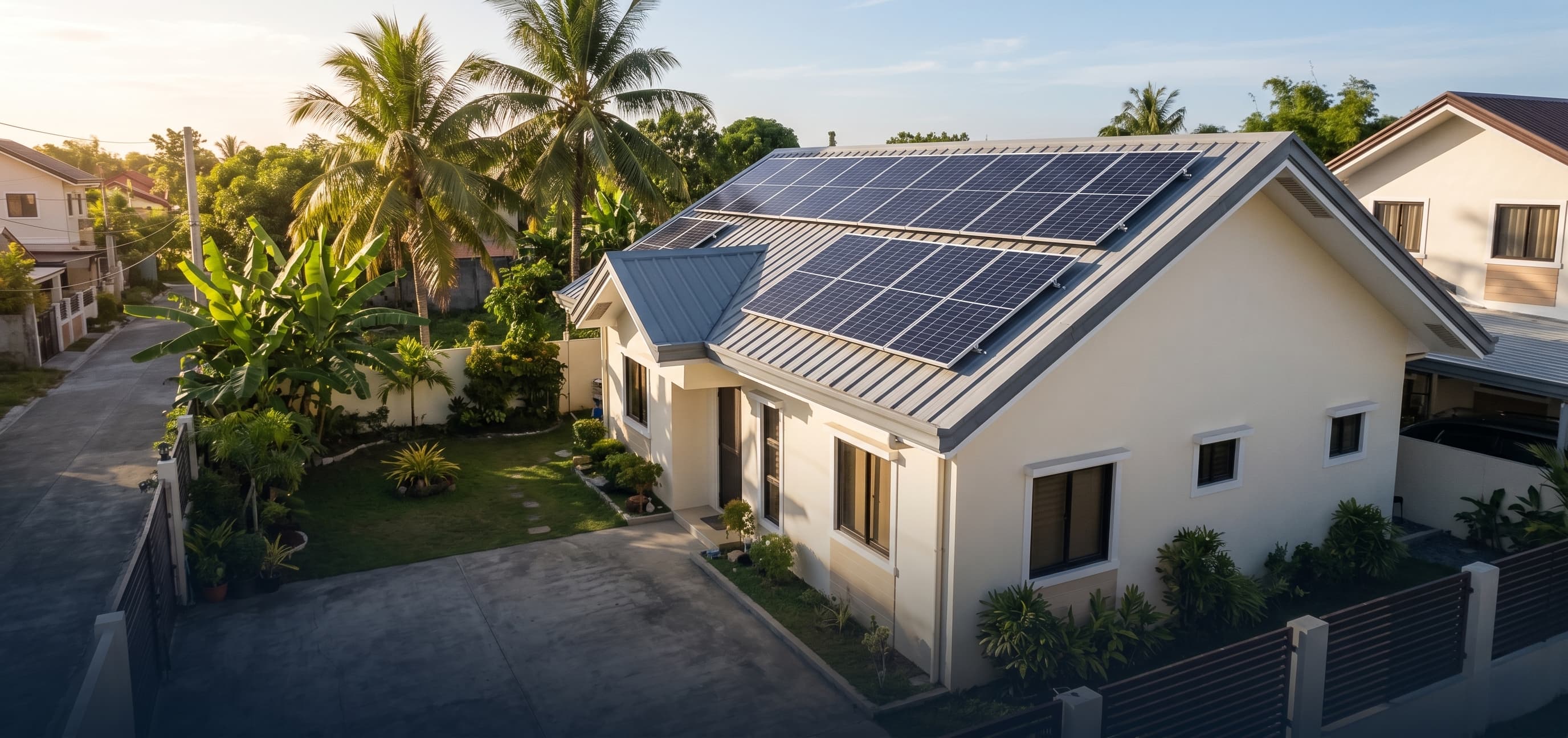
System Types
Off-Grid, Grid-Tie, or Hybrid?
Three ways solar can work for your home, each with different trade-offs on cost, reliability, and independence. Here's the technical breakdown.
Pinakapopular
Hybrid On/Off-Grid
Best of both worlds: solar + battery + grid backup
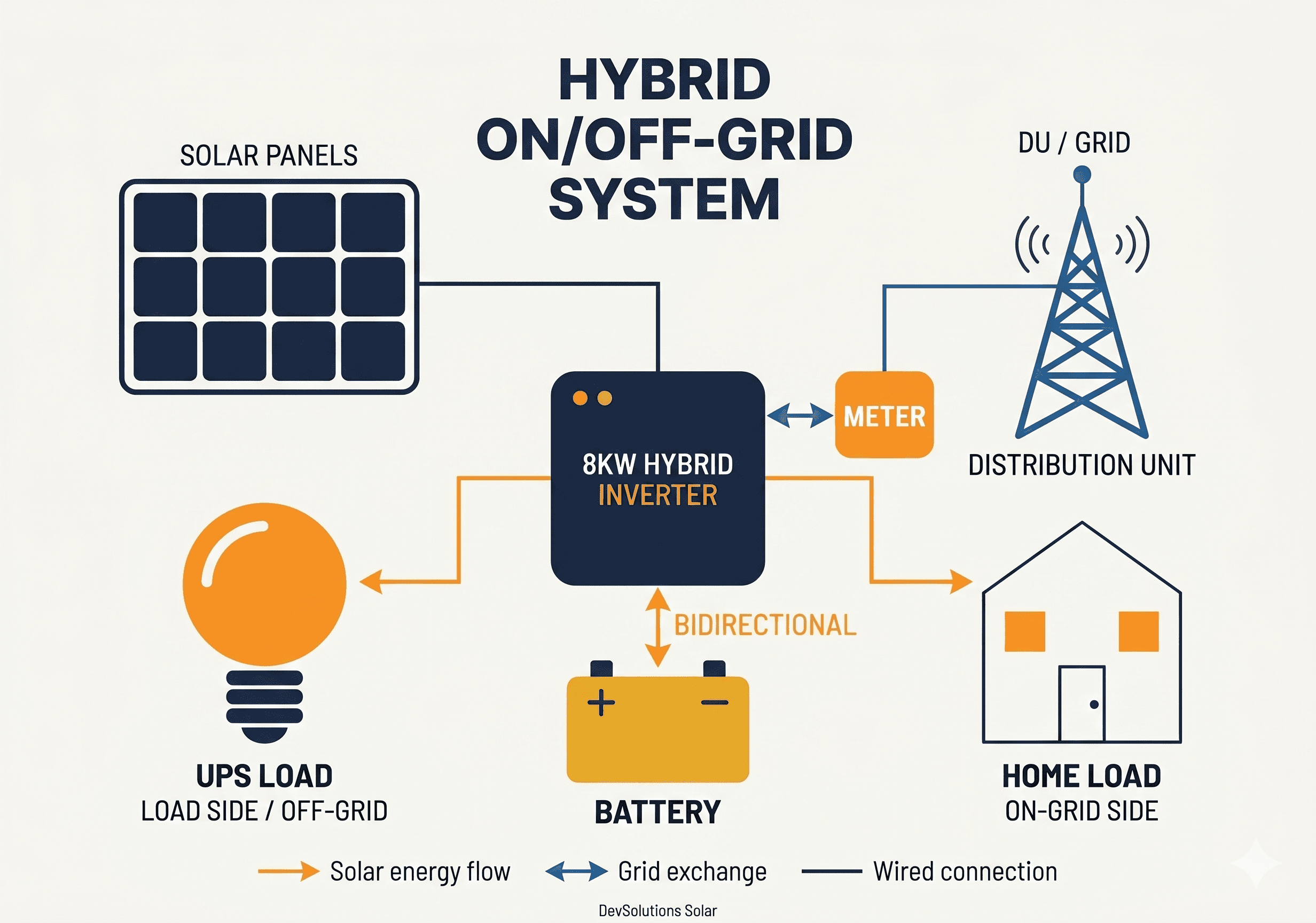
A hybrid system combines solar panels, a battery bank, and a grid connection through a single intelligent inverter. During the day solar powers your home and charges the battery. At night or during brownouts, the battery takes over. The grid stays connected as a fallback. This is the default package for most DevSolutions clients.
Representative system
6KW Hybrid (most popular)
₱378,000
When does this make sense?
Suburban home sa Cavite with occasional brownouts
Battery keeps aircon + fridge running through most outages without needing a noisy generator.
Family in Palawan running a home-based business
Cannot afford downtime during power interruptions. Hybrid keeps the workday going.
High-consumption household (₱10K+ monthly bill)
Big enough savings that the 6KW+ hybrid breaks even faster than a grid-tie system.
Advantages
- Works during brownouts, battery automatically takes over
- Lower electricity bills while keeping grid as backup
- Can export excess solar to the grid (where net metering is available)
- Modular: start without battery, add later as budget allows
- Single inverter handles everything, so wiring and service stay simpler
Trade-offs
- Higher upfront cost than grid-tie (battery adds ~₱110-125K)
- Battery replacement cycle every 10-12 years
- Slightly more complex commissioning than grid-tie
System Type
On-Grid / Grid-Tie
Pure bill offset: daytime solar, grid at night
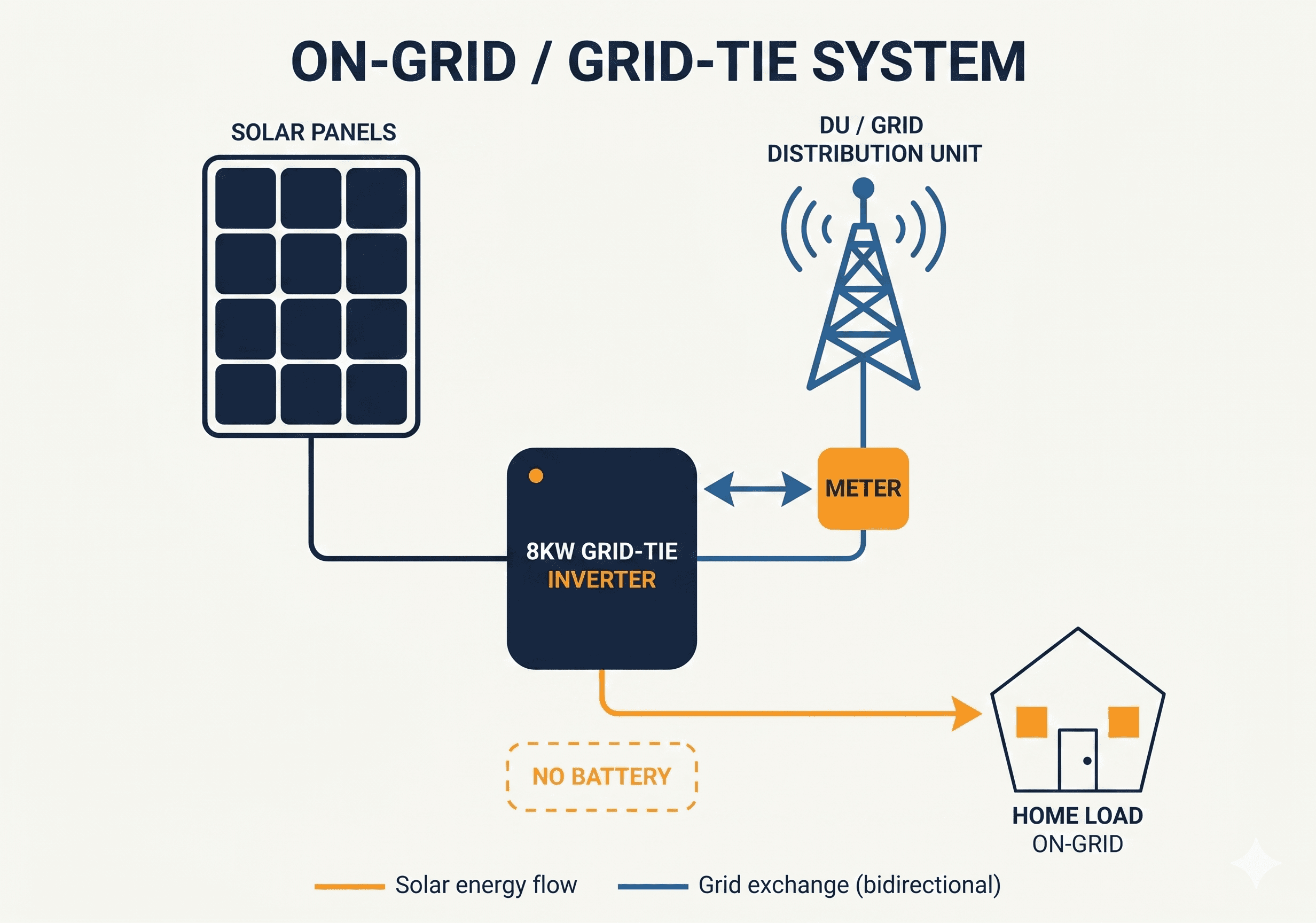
A grid-tie system feeds solar power straight into your home during the day and exports excess back to the utility grid. There is no battery, so at night your home pulls from the grid as usual. This is the simplest and cheapest solar architecture, best for urban areas where the grid is stable and brownouts are rare.
Representative system
6KW Grid-Tie (estimated)
~₱230,000
Note: DevSolutions defaults to hybrid packages. Pure grid-tie is built-to-order, so contact us for a custom quote.
When does this make sense?
Condo in Makati or BGC with stable Meralco service
Grid is reliable; battery is unnecessary overhead. Maximize savings per peso invested.
Small business with 9-5 daytime-heavy loads
Solar directly offsets the largest consumption window. Night loads are minimal.
Home in a barangay with no brownout history
The savings from skipping a battery can fund other home upgrades.
Advantages
- Lowest upfront cost: no battery, ~₱110-125K cheaper than hybrid
- Simplest architecture: fewer components, fewer failure points
- Fast payback period for daytime-heavy users (office, aircon)
- Exports excess solar to the grid (where net metering is approved)
Trade-offs
- No backup power during brownouts, it goes dark like grid-only
- Nighttime usage still pulls from grid at full rate
- Net metering approval varies by utility and can take months
- Minimal value if your area has frequent outages
System Type
Off-Grid
Complete energy independence: no utility connection
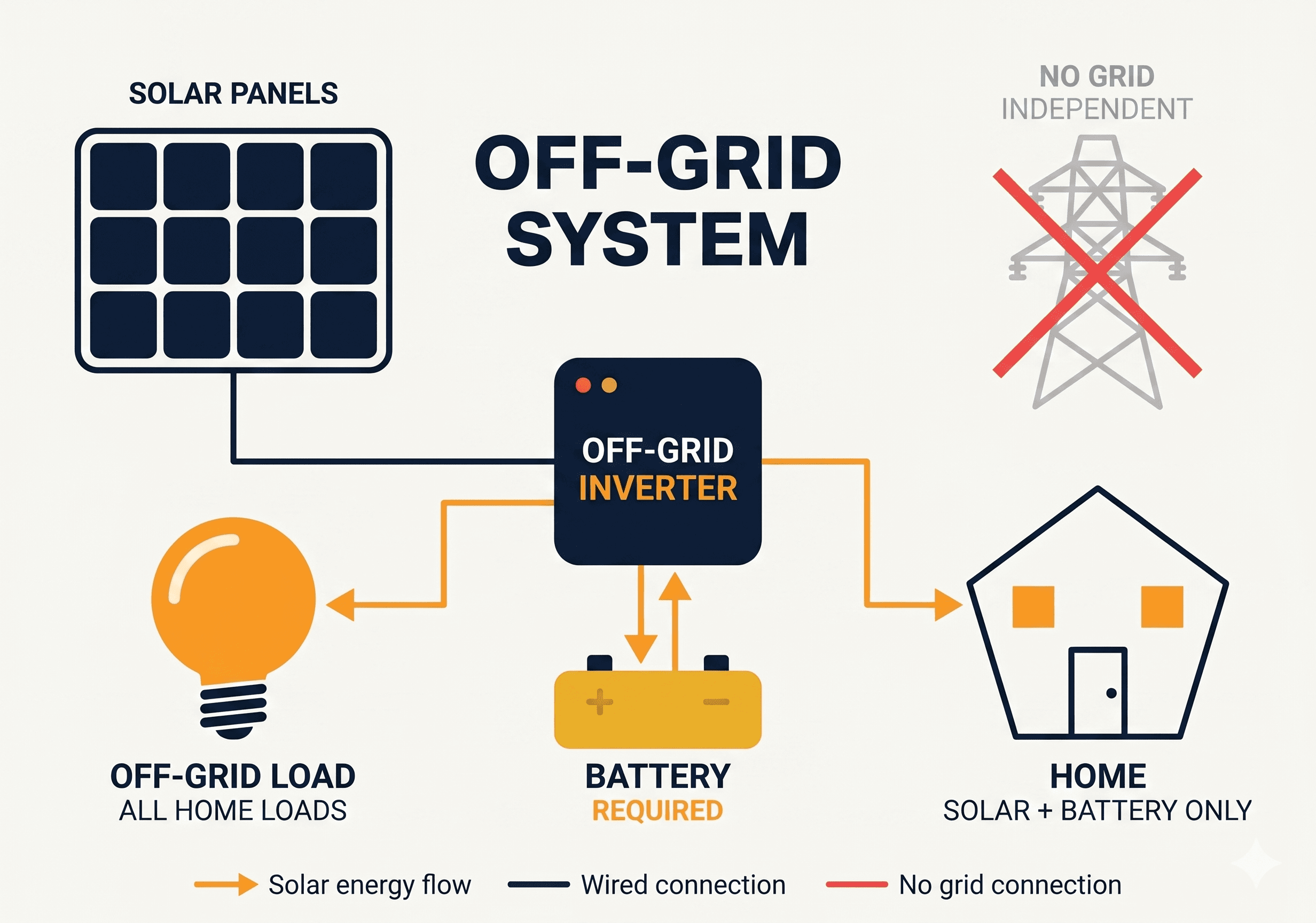
An off-grid system is fully self-contained: solar panels + battery bank + inverter, with no wire to the utility grid. The battery stores all excess solar for nighttime and cloudy days. Designed for remote properties, farms, or homes where grid service is unreliable, expensive to connect, or simply not desired.
Representative system
5KW Off-Grid
₱270,000
When does this make sense?
Farm or vacation home in Palawan without grid access
Extending utility poles would cost more than the solar system itself.
Barangay with frequent multi-day outages
When grid unreliability hurts productivity, independence pays for itself.
Eco-homestead or off-grid lifestyle by choice
Philosophical fit: values energy self-sufficiency over grid integration.
Advantages
- Fully independent: zero utility bill, zero grid vulnerability
- Works in remote areas where extending grid costs ₱200K+
- No net metering bureaucracy or utility approvals needed
- Protection from Meralco rate hikes forever
Trade-offs
- Needs a larger battery bank, so upfront cost can match hybrid
- Zero backup: if solar underproduces and the battery drains, lights out
- Requires more careful load management than grid-connected systems
- Cannot export excess solar for additional savings
Cost + ROI
What does each system cost — and when does it pay for itself?
All three architectures generate similar kWh per kW installed; the difference is what you pay upfront and how much of that energy you actually use.
| Metric | Hybrid On/Off-Grid | On-Grid / Grid-Tie | Off-Grid |
|---|---|---|---|
| Representative system | 6KW Hybrid (most popular) | 6KW Grid-Tie (estimated) | 5KW Off-Grid |
| Upfront cost | ₱378,000 | ~₱230,000 | ₱270,000 |
| Annual production | 8,370 kWh | 8,370 kWh | 6,975 kWh |
| Annual bill savings | ₱85,370 | ₱60,264 | ₱83,700 |
| Break-even point | ~4.3 years | ~3.8 years | ~3.2 years |
| 20-year net savings | ₱1,234,000 | ₱915,000 | ₱1,294,000 |
Hybrid On/Off-Grid
6KW Hybrid (most popular)
- Upfront
- ₱378,000
- Annual production
- 8,370 kWh
- Annual savings
- ₱85,370
- Break-even
- ~4.3 years
- 20-year net
- ₱1,234,000
On-Grid / Grid-Tie
6KW Grid-Tie (estimated)
- Upfront
- ~₱230,000
- Annual production
- 8,370 kWh
- Annual savings
- ₱60,264
- Break-even
- ~3.8 years
- 20-year net
- ₱915,000
Off-Grid
5KW Off-Grid
- Upfront
- ₱270,000
- Annual production
- 6,975 kWh
- Annual savings
- ₱83,700
- Break-even
- ~3.2 years
- 20-year net
- ₱1,294,000
Assumptions
- Hybrid On/Off-Grid: 6KW hybrid at 4.5 PH sun-hours/day × 0.85 derate = 8,370 kWh/year. 85% self-consumption (battery shifts solar to evening). ₱12/kWh Meralco rate. Battery replacement at year 10 included in 20-yr math.
- On-Grid / Grid-Tie: 6KW grid-tie at 4.5 PH sun-hours/day × 0.85 derate = 8,370 kWh/year. 60% self-consumption (night pulls from grid, no battery to shift). ₱12/kWh Meralco rate. No battery replacement needed.
- Off-Grid: 5KW off-grid at 4.5 PH sun-hours/day × 0.85 derate = 6,975 kWh/year. 100% self-consumption (battery stores everything). Savings calculated vs equivalent grid rate at ₱12/kWh. Battery replacement at year 10 included in 20-yr math.
These are representative figures for planning purposes. Your actual savings depend on your specific roof, consumption pattern, and utility rate. Run the Solar Estimator on the home page for a personalized calculation.
Environmental impact
What each system keeps out of the atmosphere
The Philippine grid is powered roughly 50% by coal. Every kilowatt-hour you generate from your roof is a kilowatt-hour that didn't burn fossil fuel. Here's the math per system.
Hybrid On/Off-Grid
- CO2 avoided per year
- 5,859 kg
- Trees equivalent / year
- 234 mature trees
- Lifetime (25-year) offset
- 139 tons CO2
On-Grid / Grid-Tie
- CO2 avoided per year
- 3,515 kg
- Trees equivalent / year
- 141 mature trees
- Lifetime (25-year) offset
- 83 tons CO2
Off-Grid
- CO2 avoided per year
- 4,883 kg
- Trees equivalent / year
- 195 mature trees
- Lifetime (25-year) offset
- 116 tons CO2
Sources + further reading
- Department of Energy Philippines: Grid Emission Factor
Philippine grid carbon intensity (~0.70 kgCO2/kWh) used to calculate CO2 avoided per kWh of solar produced. Grid fuel mix is ~50% coal, ~25% natural gas, ~25% renewables.
- IRENA: Philippines Country Profile
International Renewable Energy Agency country profile with PH solar potential, policy landscape, and deployment data.
- IEA: Philippines Energy Statistics
International Energy Agency country data covering PH electricity generation, consumption, and decarbonization trajectory.
- EPA Greenhouse Gas Equivalencies Calculator
US EPA calculator used for trees-equivalent translation (25 kgCO2/tree/year average for mature hardwood).
- Meralco Rate Information
Meralco tariff updates. ₱12/kWh used as representative generation + delivery rate for ROI calculations.
Ready to go solar?
See Your Numbers Before You Commit
No forms to fill out just to see a price. No calls to book. Just tap your appliances and see your exact system size and price on the spot, then the team follows up with your personalized quote.
Transparent math · Self-service quote · Team reaches out to ready buyers only